







When the hydraulics slow down, the whole site slows down
A backhoe loader with a sluggish boom, an excavator that loses power by afternoon, a press that starts jerking mid-shift: on a construction site, farm or factory floor, hydraulic problems cost more than repairs. They cost working hours, missed deadlines and hire income.
Often the fix is not a new pump. It is the right hydraulic oil, in the right grade, kept clean. Here is how to choose it.
What does hydraulic oil do?
- Transmits power: the pump pushes nearly incompressible oil to move cylinders and motors with great force.
- Lubricates: it protects pumps, valves and motors running at very high pressures.
- Removes heat: it carries heat from the pump and valves back to the tank and cooler.
- Seals clearances: the right viscosity keeps oil from slipping past tight internal gaps.
- Carries contaminants to the filter: it keeps dirt moving to where it can be trapped.
ISO VG 32 vs 46 vs 68: what the numbers mean
Hydraulic oils are graded by ISO viscosity grade (ISO VG), which is the oil’s kinematic viscosity in centistokes (cSt) at 40°C, within a tolerance of ±10%.
| Grade | Viscosity at 40°C | Typical use |
|---|---|---|
| ISO VG 32 | 28.8–35.2 cSt | Cold starts, machine tools, precision and indoor industrial systems in cooler conditions |
| ISO VG 46 | 41.4–50.6 cSt | The all-round grade for most mobile and industrial hydraulic systems |
| ISO VG 68 | 61.2–74.8 cSt | Hot climates, heavily loaded mobile equipment, high operating temperatures, where the manual allows |
What does “AW” mean on hydraulic oil?
AW stands for anti-wear. AW hydraulic oils contain additives that form a protective film on pump and valve surfaces when pressure squeezes the oil film thin. They are the standard choice for gear, vane and piston pumps in construction and industrial equipment.
Quality AW hydraulic oils also resist oxidation, release trapped air, separate water and control foam. These properties matter as much as viscosity. Look for recognised specifications such as DIN 51524 Part 2 (HLP) or ISO 6743-4 HM on the label.
What happens when the viscosity is wrong?
| Oil too thin for the temperature | Oil too thick for the temperature |
|---|---|
| Internal leakage past pumps, valves and cylinder seals | Sluggish, slow response at start-up |
| Slow, weak cylinders and drifting booms when hot | Pump cavitation (a whining noise) as oil struggles to enter the pump |
| Metal-to-metal wear in the pump | Higher power draw and fuel use |
| Overheating, which thins the oil further | Poor filtration and air release |
The goal is for the oil to stay inside the machine maker’s recommended viscosity window at the temperatures your machine actually runs at, from a cold winter start to a full afternoon of digging in the summer.
Choosing hydraulic oil for Indian conditions
Machines in India face heat, dust and long shifts. Use these rules within your manual’s recommendation:
- Hot regions and summer work: in Rajasthan, Gujarat, Telangana and central India, where machines work through 40°C+ afternoons, the higher grade your manual permits (often VG 68 for mobile equipment) holds viscosity better.
- Cold regions and winter starts: in hill construction, Jammu and Kashmir, Himachal or North Indian winter mornings, VG 46 or VG 32 (if permitted) avoids cavitation at start-up.
- Year-round single grade: if you cannot change grades seasonally, choose the grade the manual lists for your typical operating temperature range, and warm the machine up before full load.
- Heavy-duty cycles: continuous digging, breaker work and loading raise oil temperature, so check coolers and oil level frequently.
- Never mix grades or types casually: topping up VG 46 into a VG 68 system shifts viscosity and can mix incompatible additives.
Backhoe loaders, excavators and construction equipment
Backhoe loaders (widely called “JCBs” in India), excavators, cranes and loaders run high-pressure hydraulic systems that work almost continuously. Always follow the fluid specification on the machine’s plate or in its operator’s manual: some machines use a dedicated hydraulic oil, while others share one fluid between the transmission and hydraulics.
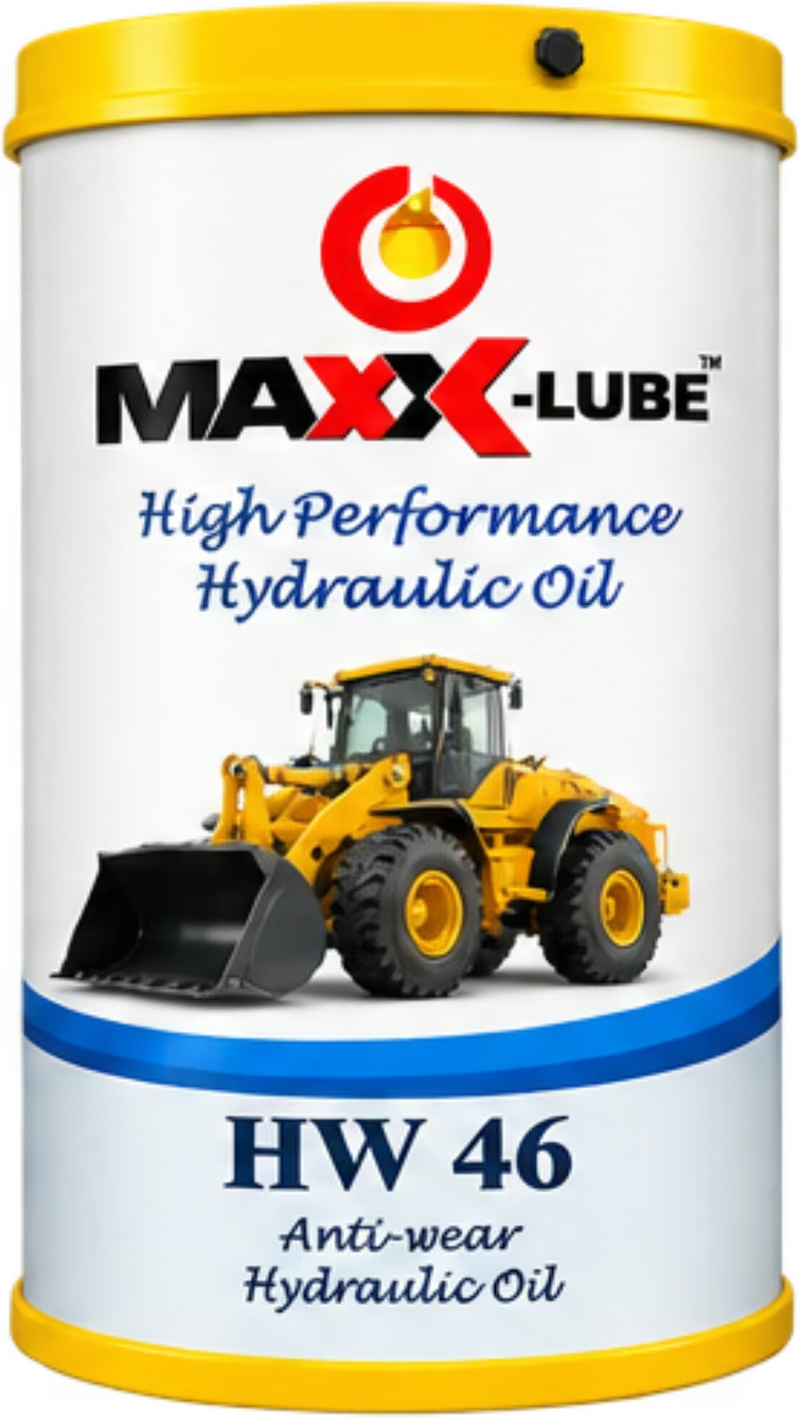
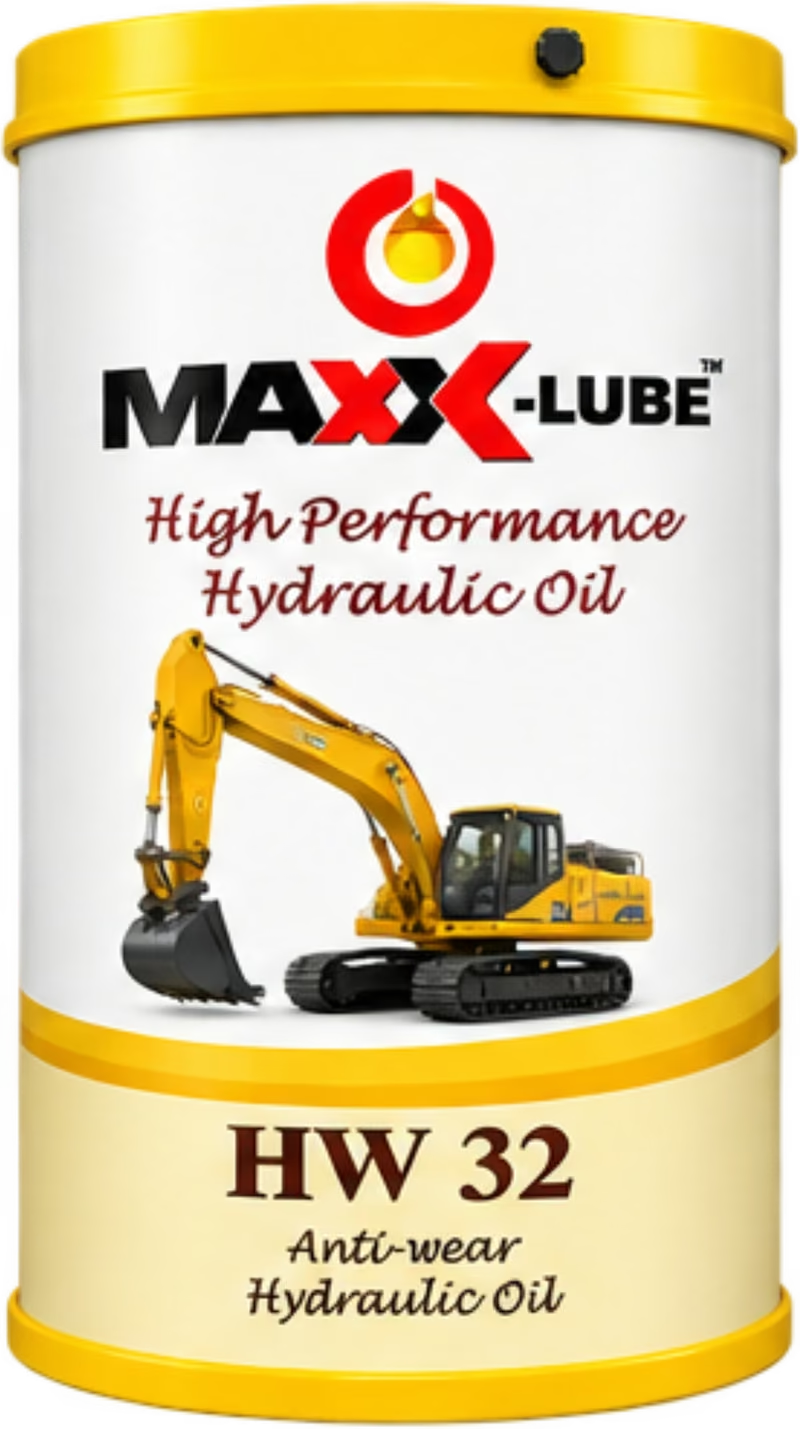
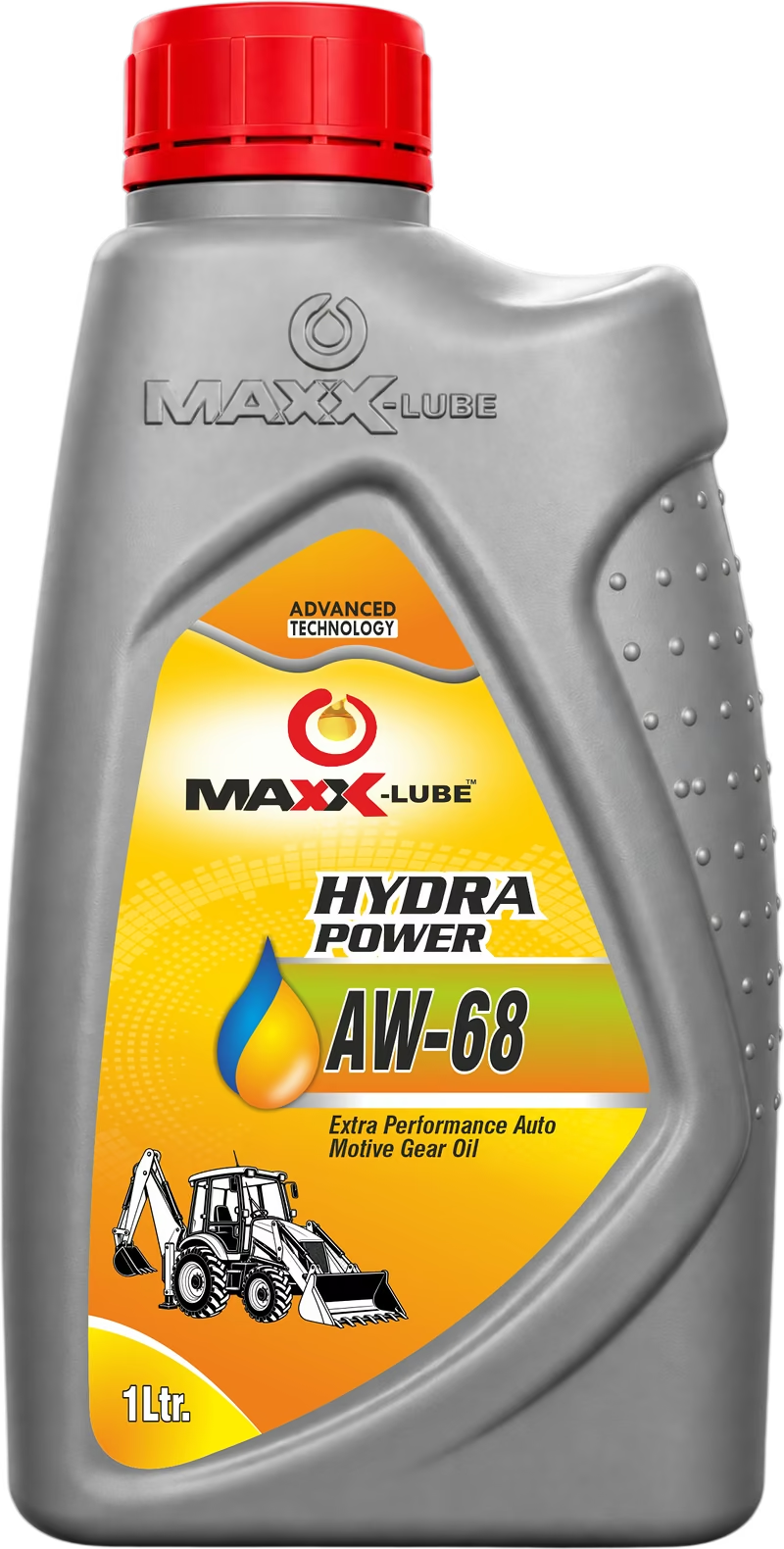
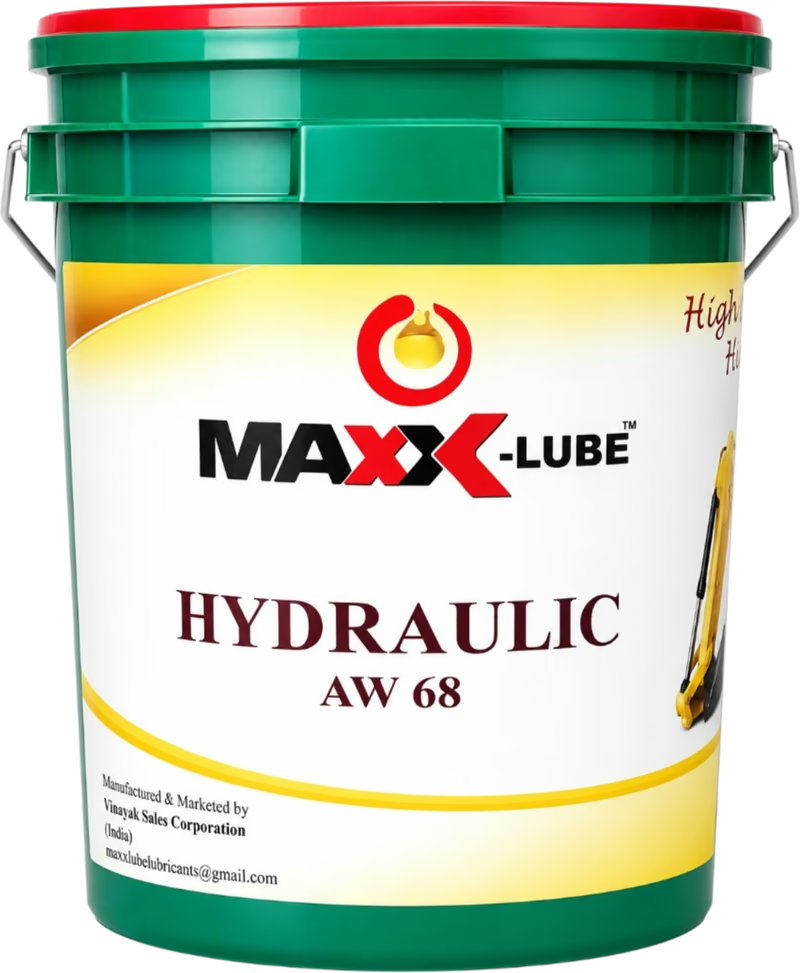
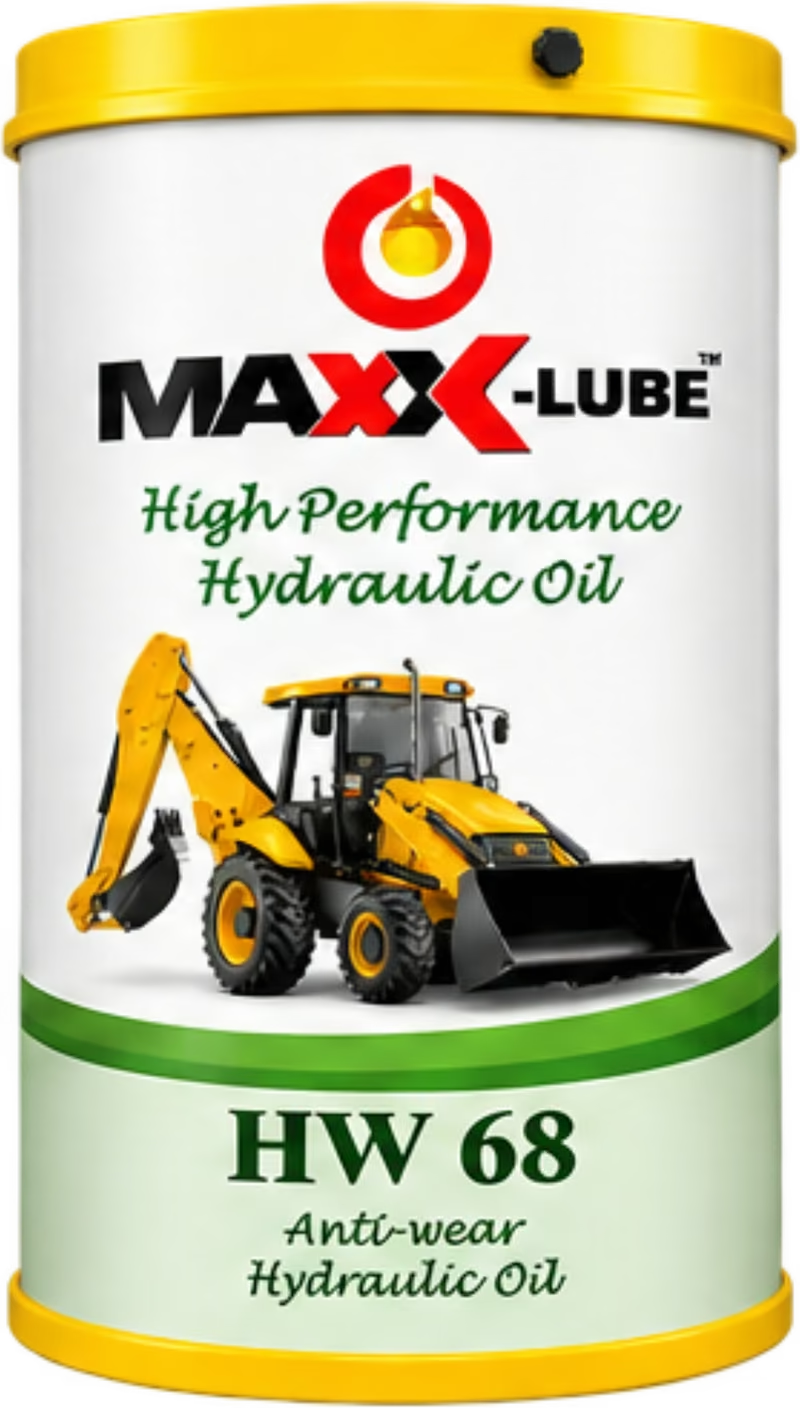
Where an AW hydraulic oil is specified, operators in hot Indian conditions commonly run ISO VG 68, and VG 46 where the manual calls for it or the climate is cooler. MAXX-LUBE HYDRAULIC AW-68 and HYDRAULIC HW-32 or HW-46 come in 26 litre tins and 50, 55 and 210 litre drums (AW-68 also in 1 and 5 litre packs) for site and fleet use.
(JCB is a registered trademark of its owner and is used here only to describe the type of machine.)
Tractors: check before you pour
Many modern tractors use a single transmission-hydraulic oil that lubricates the gearbox, powers the hydraulic lift and cools oil-immersed (wet) brakes and PTO clutches. These oils need special friction properties. Do not replace it with plain AW hydraulic oil unless the tractor manual specifically allows it, or brakes may chatter and clutches may slip.
Keep it clean: contamination is the real enemy
Contamination is the leading cause of hydraulic pump and valve failures. Clearances inside hydraulic components are extremely small, so even fine dust does damage. Protect your oil:
- Use clean containers and funnels to top up. Never use buckets that held other fluids.
- Wipe the filler cap area before opening, especially on dusty sites.
- Change filters on schedule, and replace the tank breather filter too.
- Keep drums sealed and stored lying on their side or under cover, so rainwater cannot collect on the lid and get drawn in.
- Watch for water: milky or cloudy oil means water entry. Find the source and change the oil.
- Consider oil analysis for high-value fleets. A small sample shows wear metals, water and dirt before a breakdown does.
Warning signs of hydraulic oil problems
| Symptom | Possible cause |
|---|---|
| Milky or cloudy oil | Water contamination |
| Foam in the tank | Air leaks on the suction side, low oil level or worn-out oil |
| Pump whining or screaming | Cavitation from oil too thick, clogged suction strainer or low level |
| Slow or jerky cylinders when hot | Oil too thin, internal leakage or worn pump |
| Overheating | Wrong grade, blocked cooler, overloading or low oil level |
| Dark oil with burnt smell or varnish | Oxidised oil overdue for change |
MAXX-LUBE hydraulic oils
- HYDRAULIC [HW-32](/products/hydraulic-oils/hydraulic-32) and [HW-46](/products/hydraulic-oils/hydraulic-46), ISO VG 32 and 46: anti-wear hydraulic oils for industrial machinery, presses, loaders and excavators, in 26 litre tins and 210 litre drums.
- [HYDRAULIC AW-68](/products/hydraulic-oils/hydraulic-68), ISO VG 68: anti-wear hydraulic oil for high-pressure systems and heavy equipment working in hot conditions, from 1 litre HYDRA POWER bottles to 210 litre drums.